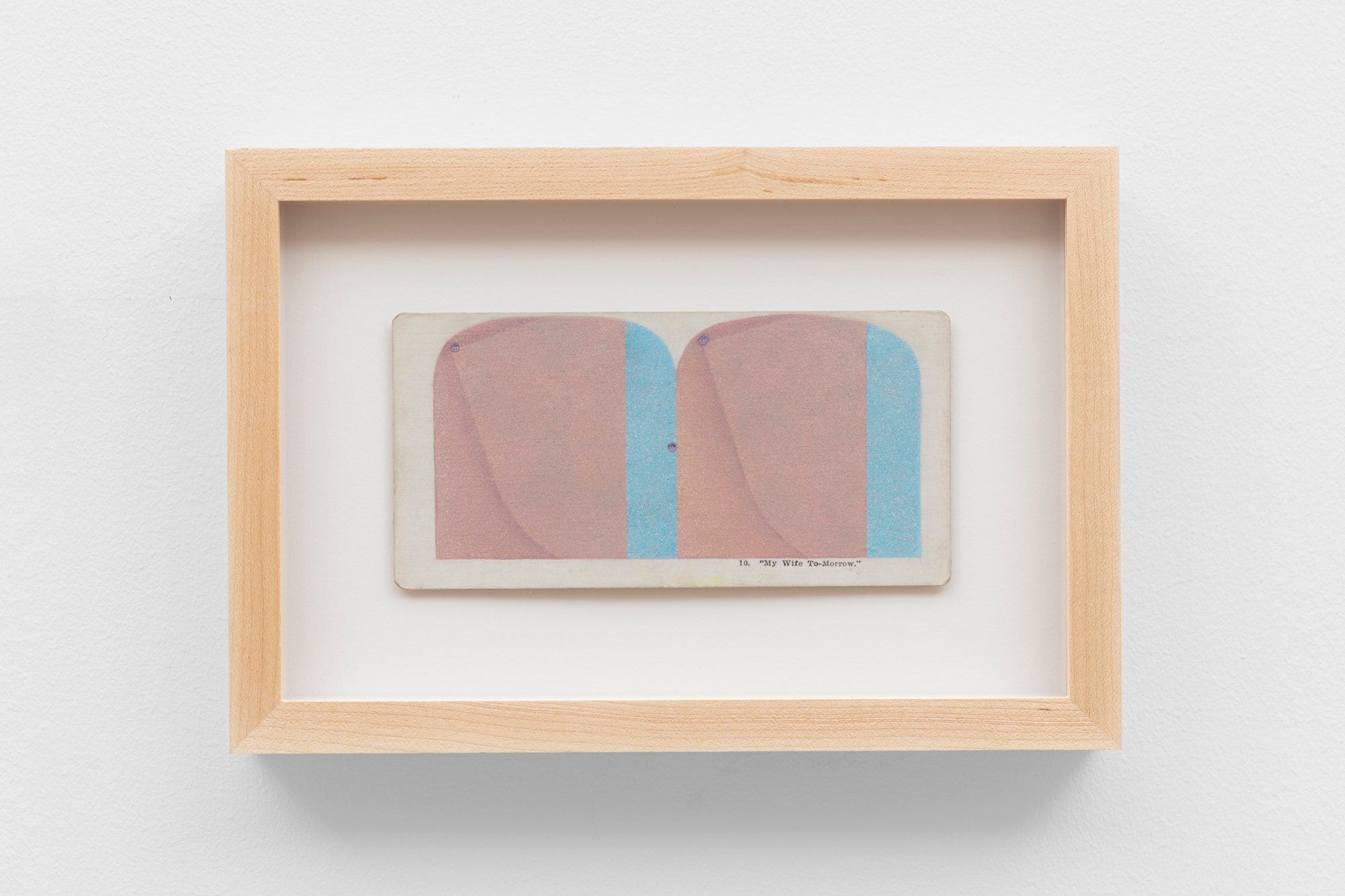
Another piece we are “hosting,” this one by Harmon Siegel on Sally Scopa’s stereoscopic paintings at Oolong Gallery, presented here in its entirety.
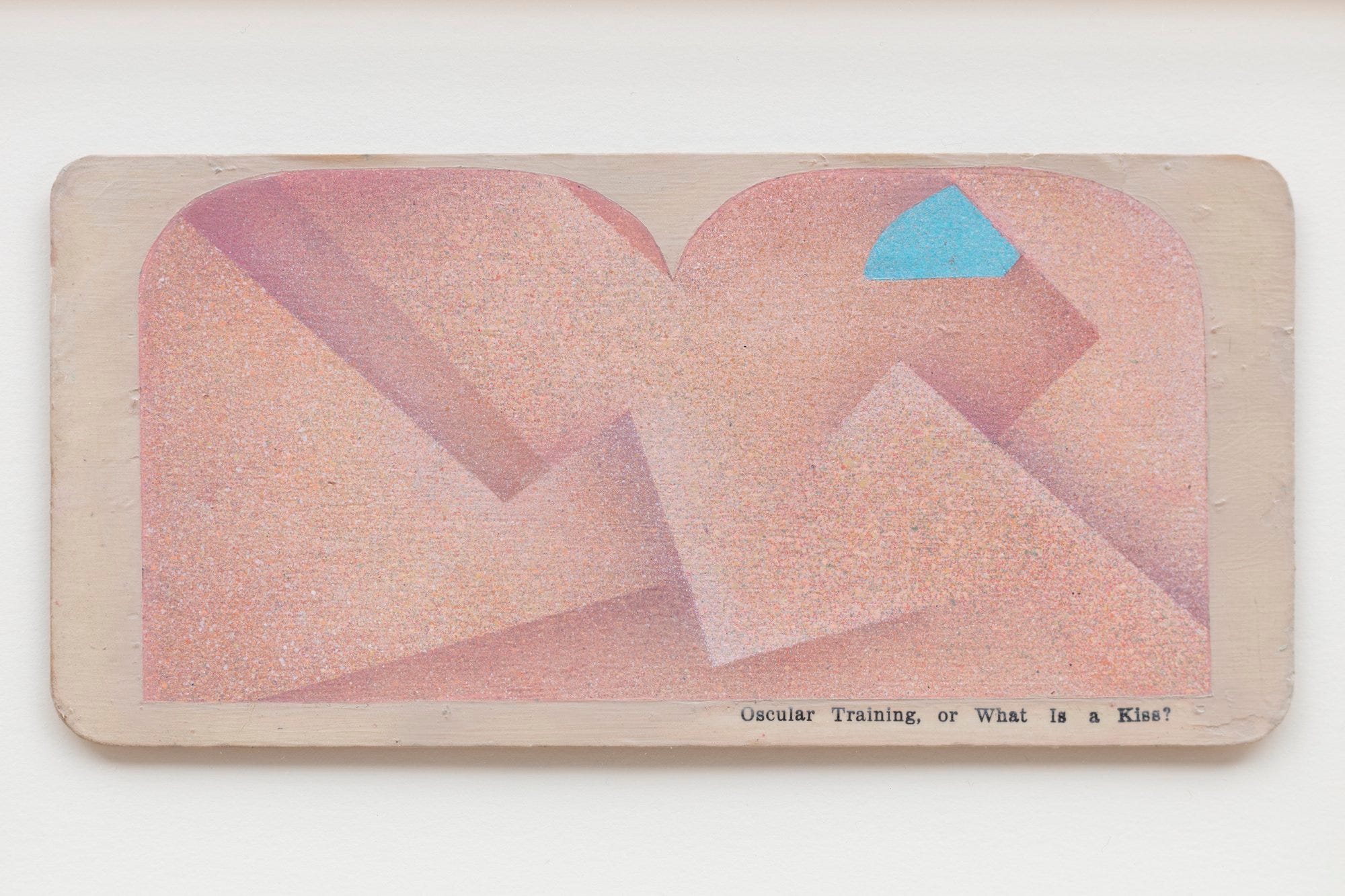
Sally Scopa paints abstractly on stereographic cards, invoking the twin histories of two pictorial traditions. The cards themselves reference a way of producing an illusion of three-dimensional depth. Her painted forms, meanwhile, recall early twentieth-century non-objective artists such as Hilma af Klint and Paul Klee, painters who realized that two dimensions could be beautiful as such. Scopa’s works thus ask: can these inverse trajectories be reconciled?
Stereographic devices suggest depth using binocularity. To recreate interocular distance, a dual-lens camera captures the same subject from slightly different angles. When inserted into a viewing device, the resulting pair of images appears to fuse, imparting a sense of three-dimensionality. With this technique, stereoscopic photography epitomized an illusionistic conception of what pictures are for. We are not fooled, of course, not least thanks to the somatic sensation of the lenses against our eyes. Yet we take pleasure in the disparity between what we know and what we see as the paper vanishes before us like a magician behind a curtain.
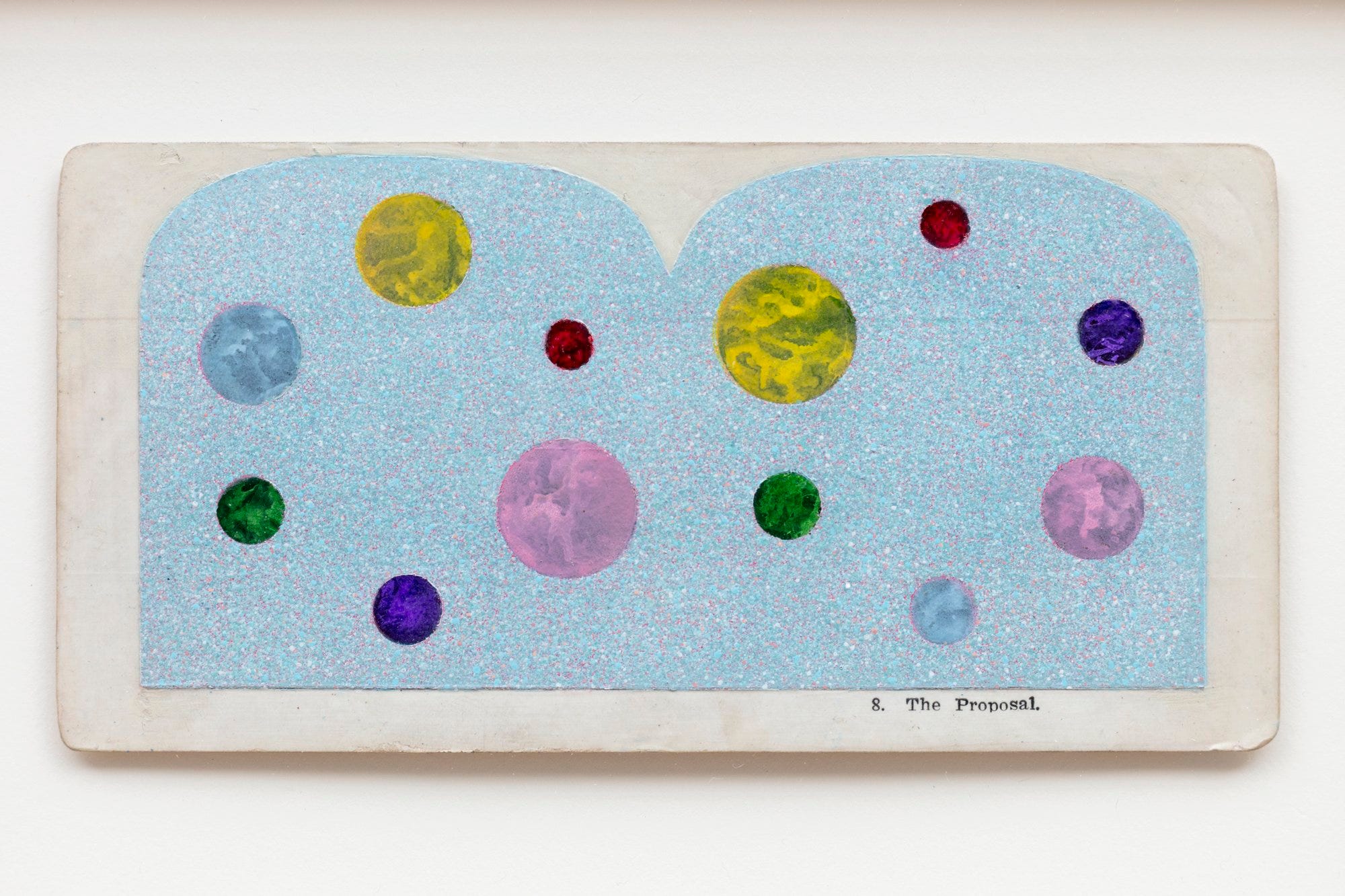
Scopa’s slides belong to a set playfully narrating the journey from courtship to marriage. While her paint obscures the underlying images, she retains their labels, which caption the various abstractions with phrases like “The Bashful Lover Makes His First Call” and “Second Call. Improvement on Call No. 1.” Of course, such descriptions suggest figurative readings of the abstract patterns. In some cases, I can imagine the lines and shapes as the lovers à la Norton Juster’s The Dot and the Line. Because we cannot help but associate left-to-right movement with temporal progression, slides where repeated motifs change places suggest a kind of two-step dance.
This play is facilitated by the works’ size. Because they were made to be inserted into a viewer, the cards are small. The works are accordingly not well served on the gallery wall, which swallows them up. I’d be curious to view them instead unframed on a table—aligned with the stereoscope as domestic entertainment rather than with the notional autonomy of wall-bound abstract art—or, inversely, to see the images blown up to a more monumental scale, maintaining the reference to stereography without the literal support.
The strongest paintings are those that emphasize bilateral difference. The problem of symmetry has always dogged abstract painting as avant-gardists sought to avoid the decorative staidness of repeated motifs. When Scopa minimizes the difference between panels—doubtless trying to invoke the peculiar appearance of stereographic cards when seen without viewers—the works become static (though her application, which yields an almost rocklike speckled texture, saves them from total inertia). When she embraces disparity, they reanimate. That this result disconnects the composition from the logic of the stereoscope indicates the challenge of combining the two idioms—of a photographic technology premised on creating depth effects and a painterly tradition that minimizes them to the optical separation among planes. On the other hand, these sources successfully merge in Third Call. Mother Wants to Know if He’s Coming, which uses contrasting pinks and blues (each punctuated by two star-like yellow dots) to divide the panels. This simple differentiation somehow balances the optical effects of abstract painting with the compositional repetition of stereographic images. My favorite works, like The Proposal and “My Wife To-Morrow.”, allude to the underlying slides’ illusionistic ambition while reducing three-dimensionality to its minimal markers—chromatic separation and the cubistic invocation of shadow. In these, Scopa intimates that painting will never finish dancing with depth.
— Harmon Siegel