

Why fear the negative review?
The obvious answers don't stand up to scrutiny.
The one question that seems to arise in nearly every conversation that I have had about Artlance is: How do you handle a negative review? The “you” in this question shifts, from how Artlance intends to handle the negative reviews that writers will inevitably submit, to how commissioners will handle negative reviews of their shows or projects from those writers.
I can answer directly for Artlance in the former case: there’s nothing to “handle” — Artlance writers will write what they’re going to write; as long as the writing meets the commissioned criteria and Artlance’s standards of engagement, the opinion, the evaluation, is up to the writer alone.
And I can suggest how I believe commissioners should respond in the latter case: honest critique from an excellent art critic is valuable (I’m tempted to say that only honest critique from an excellent art critic is valuable), and so a commissioner should want that honest critique, be it received as positive or negative.
I have also suggested that, should a commissioner disagree with a writer’s opinion or evaluation, then commission again, and give the next writer the remit to respond to the first writer. Critics love nothing more than to disagree with one another. The challenge has been that they are given very little incentive to do so.
The more interesting question to consider is just why this question keeps getting asked. How is it that the negative review, the negative take, has become something to be feared, particularly in a discursive landscape where there no longer roam any alpha predators of the Clement Greenberg or Pauline Kael or Ben Brantley type? “Once upon a time the critic exercised some authority in the world of art and culture…” is the opening to the most boring of our era’s just-so stories.
In April of 1967 Donald Judd began a brief essay on Jackson Pollock with this: “Not much has been written on Pollock’s work and most of that is mediocre or bad. And not much more has been written on anyone’s work and usually not with any more thought. Art criticism is very inferior to the work it discusses.”1 In three sentences Judd throws the entire edifice of art writing under the bus. It’s an even deadlier throw when you consider that Judd, by the mid-1980s, thought that there were fewer than 100 good artists at that time, anywhere.
Two months later Michael Fried would publish “Art and Objecthood,” which many readers took to be a direct attack on the work that Judd and others were making. But consider what Fried had to say about Judd on the occasion of the latter’s first solo show at The Green Gallery in 1964: “As one might expect on the strength of Judd’s monthly criticism in Arts Magazine, it is an assured, intelligent show; it also provides a kind of commentary on the criticism and is doubly interesting on that account.” Fried recognized that Judd’s art was criticism by other means, an implicit (negative) reflection on the art of the time. At the end of his review, Fried even calls Judd’s show “the best on view in New York this month.” But that’s not the review that arguably made Judd’s career.
Such approbation is not at odds with the conclusions that Fried would come to within a few years; it informs them. And Fried’s “negative” review — for “Art and Objecthood” is very much that: a summation of assessments of what he’d been seeing in New York in the years prior to 1967, the bulk of which, including Judd’s work, he decided didn’t even rate as art! — did more for what came to be called “minimalism” than perhaps any other piece of writing of the period or after.
Think of it. Would Tony Smith’s Die be the work it is, sitting in the National Gallery, without Fried’s casting of it as “theatrical”? Would a story about a trip on an unfinished stretch of New Jersey turnpike come to define the next 30 years of art-making and discourse?2 Without Fried’s negative critique, it’s quite possible Smith’s work and so much that became affiliated with it would stand today as mere NPCs in the game of post-WWII American modernism.
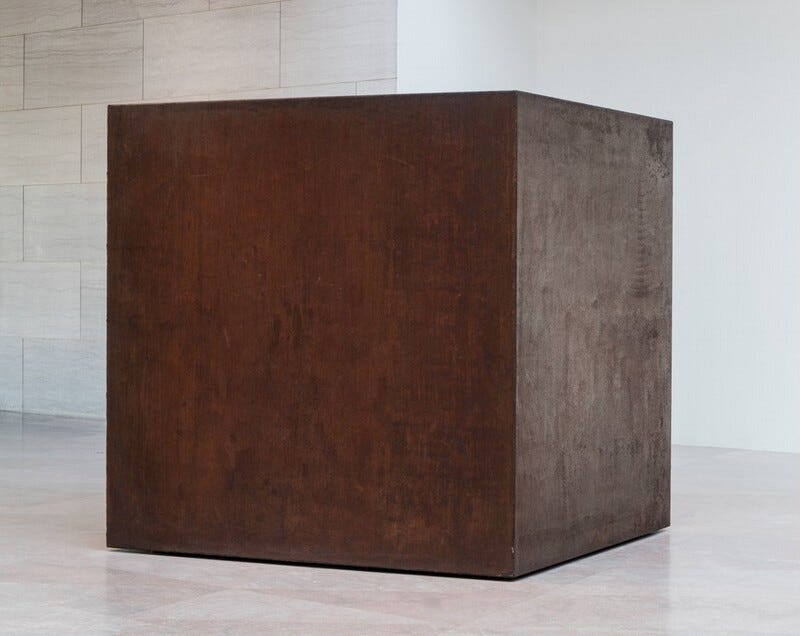
That’s a pedantic way of saying that all press is good press. And not just for the attention that it generates or drives, but because—in the case of writing about art, writing that is often considered negative—it sharpens how others come to see the work.
The fear of the negative review resembles nothing so much as those fears that underwrite the censorious reflex: we can’t let someone read such a negative take, we cannot give those ideas an airing or a platform, because they are too dangerous or damaging to even consider. We are too easily swayed in our opinions, in our mere thoughts. Just to allow something potentially disagreeable to be heard or read would be to risk others’ agreeing with it. Art criticism is in essence a rhetorical affair, but how dare one attempt to persuade, or even to raise questions. Don’t you know how authoritarianism begins? With “author…” Just read the Republic; it’s all there.
One need not be a conspiracist of ideas to fear the negative review, of course; we can just as easily be conspiracists of “the market,” whose invisible hand shapes our behavior in all transactions, not just those involving money. But as I have written elsewhere, the marketplace for visual art, both its objects and its experiences, has evolved so as to erode the place and the stakes of art criticism at present, and whether one recognizes it or not, that is eroding the place and the stakes of art itself.3
Judd goes on to mention Bryan Robertson’s book on Pollock from 1960, but only to state that “its text is useless.”
When I was teaching at Cooper Union in the first year or two of the fifties, someone told me how I could get onto the unfinished New Jersey Turnpike. I took three students and drove from somewhere in the Meadows to New Brunswick. It was a dark night and there were no lights or shoulder markers, lines, railings, or anything at all except the dark pavement moving through the landscape of the flats, rimmed by hills in the distance, but punctuated by stacks, towers, fumes, and colored lights. This drive was a revealing experience. The road and much of the landscape was artificial, and yet it couldn’t be called a work of art. On the other hand, it did something for me that art had never done. At first I didn’t know what it was, but its effect was to liberate me from many of the views I had had about art. It seemed that there had been a reality there that had not had any expression in art.
As quoted in Fried’s “Art and Objecthood” (1967), reprinted in Art and Objecthood: Essays and Reviews (Chicago, 1998).
A decade ago, the artist Martha Rosler decried the tendency she was detecting from everyone in the art world—at least in the administrative, professional, public-relations oriented art world—of being too “nice.” As she put it, “much of the institutional apparatus in charge of distribution, circulation, publicity, and sales is on a long-term charm offensive,” an offensive necessitated, according to Rosler, by “neoliberal economies” that demand “the wholesale invention, performance, and perpetual grooming of a transactional ‘self’.”
I for one am just fine with that “institutional apparatus” functioning with a certain adornment of “niceness” so long as it is decorating a healthy body of civility and respect (is it asking too much to say “intelligence” too?). Stay long enough in the vicinity of art world institutions—or just in the world at large—and one learns quickly how people can be pretty awful to one another. An art world where everyone is acting like a dick and justifying it as critical resistance to capitalism sounds at best like a semi-humorous satire.
But Rosler may have been on to something about how this imperative to be nice makes its way into our language and communications. “The emoticon or emoji and the lowly exclamation point, not to mention the simple LOL,” Rosler writes, “have attached themselves to our words, to reassure ourselves and our readers. But both such shaded communications (especially sarcasm) and the signs of reassurance are often inappropriate in business dealings, inducing the anxiety that our emails may be misread; hence the anxiety-ridden formulaic greetings of joy! glee! and full engagement!” We are exceedingly driven to caring for our interlocutors, caring for their feelings as much as for the clarity of our own intentions when writing and speaking.
One could ask: When we begin to take such care in our communications, is it any wonder that the edge of critique might get worn down? But this would be the wrong question. Because the opposite of care is indifference: we attend to something, and by doing so we don’t attend to something else, and it is this logic, the logic of care and indifference, the logic of selection, of “this not that”—the logic of curation, one could say—that governs the theory and practice of art criticism today, i.e., what gets written about and what doesn’t. After all, today, to get a review of a show is what matters. And most writers don’t want to spend what precious column inches they do get writing about something they might dislike or disagree with.
As critics we need to care for sure, but we need the room and the reasons to care enough to disagree, to leave the logic of curation to the curators and collectors, and to return to a logic of critique, the “this, not that, because….”
my very first gig as a writer was in 1995 and 1996 for an online only (in 1995!) art magazine hosted on the Vienna server of the thing.net, called blitzreview. The negative reviews inevitably were the most fun to write and the one's that got the most comments and discussion. I miss writing them.